Microstates
2026-10-11

I grew up in Central Maine. As a teenager, I learned how influential many of the senators from our region were, such as Margaret Chase Smith, George Mitchell, and Edmund Muskie.
They were all very accomplished leaders.
But part of their influence may have due to the disproportionate power smaller states have in the federal government, particularly in the Senate.
Recently I went down a rabbit hole exploring how small a US State could actually be, and how it could be used to get wildly disproportionate national impact. This led to learning a lot about historical precedents, court rulings on Gerrymandering, and many other related topics.
This post shares what I've learned.
Disclosure: I used AI (Claude, ChatGPT, Gemini) in researching this post and to generate material. I reviewed, wrote sections, and did the final edit pass myself.
What the Constitution Actually Requires
New states are governed by Article IV, Section 3:
New States may be admitted by the Congress into this Union; but no new State shall be formed or erected within the Jurisdiction of any other State; nor any State be formed by the Junction of two or more States, or Parts of States, without the Consent of the Legislatures of the States concerned as well as of the Congress.
For a state carved out of an existing state, three approvals are needed:
- The legislature of the state being carved up.
- Both chambers of Congress, passing the admission bill.
- The President, by signing the admission bill.
Article IV's text names only the first two. The President's role is there because admission is accomplished through ordinary legislation, which means it goes through the normal Article I, Section 7 presentment process like any other bill. If the President vetoes it, two-thirds of each chamber of Congress can override.

How thin can the state legislature's consent actually be? West Virginia is the clearest illustration. When it split from Virginia in 1863, Virginia's government had already seceded and joined the Confederacy, so the "consent" Congress accepted came from a breakaway, Unionist legislature controlling only the state's western counties. Lincoln himself doubted the bill's constitutionality but signed it anyway under wartime pressure. Virginia did eventually get a hearing at the Supreme Court, in Virginia v. West Virginia (1871) - but only over whether two additional counties, Berkeley and Jefferson, had properly joined the new state after the fact, not over whether the original 1863 separation was constitutional at all. That bigger question was never squarely presented to the Court and has never been decided. Once a new state exists and Congress has admitted it, nobody with standing to challenge it seems to have much appetite for trying.
Congress admitting a State is treated like any other bill, and in theory only requires majority vote in both the House and the Senate. However, in the Senate the minority party would almost certainly filibuster something as consequential as a state admission. So in practice a majority would be needed in the House, and a super-majority of 60 votes in the Senate to invoke the Cloture Rule.
Once admitted, the Constitution's own text gives every state, new or old, the same baseline representation regardless of population:
- Two Senators, guaranteed by Article I, Section 3, and further locked in by Article V, one of the Constitution's two original express limits on the amendment power.
- At least one Representative, guaranteed by Article I, Section 2, regardless of population.
- Electoral votes guaranteed by Article II, Section 1: House seats plus Senate seats, so a minimum of three regardless of how small the state is.
Does the Constitution say anything else about what a state needs to look like? Article IV gives Congress broad discretion over admission. The one textual guardrail is the Guarantee Clause in Article IV, Section 4, which requires a "Republican Form of Government" - though courts have generally left it to Congress to judge what that means, rather than enforcing it as a checklist. Beyond that, the Constitution does not specify a minimum physical size threshold. Current states span a roughly 400x range by total area from Rhode Island to Alaska. The Constitution also does not specify a minimum population threshold. From the 2025 Census Bureau, there is a 67x range in population from Wyoming to California.
Since the Constitution does not restrict minimum size, what has historical precedent shown?
Historical limits on state size
Congress has never actually tested the constitutional floor, but it has come close, and every time it did, the population requirement it applied was a policy choice made in that admission act - not something the Constitution demanded.
| State | Admitted | Population at admission | Why it went through |
|---|---|---|---|
| Nevada | 1864 | ~40,000 | Rushed through before the 1864 election to help re-elect Lincoln and secure ratification of the 13th Amendment; silver wealth made the case politically easier to sell. |
| Wyoming | 1890 | ~60,000 | The tail end of a Republican push to admit sparsely populated western territory - see below. |
Nevada and Wyoming are the two smallest states ever admitted by population, and both cases share the same underlying pattern this piece keeps coming back to: a party that already held the White House, the Senate, and the House used that control to add a small, reliably friendly state.
Nevada's admission in 1864 happened under a Republican-Union trifecta built almost entirely out of the Confederacy's own Democrats being absent from Congress during the Civil War. This was not a close call, just a party with the numbers choosing to use them.
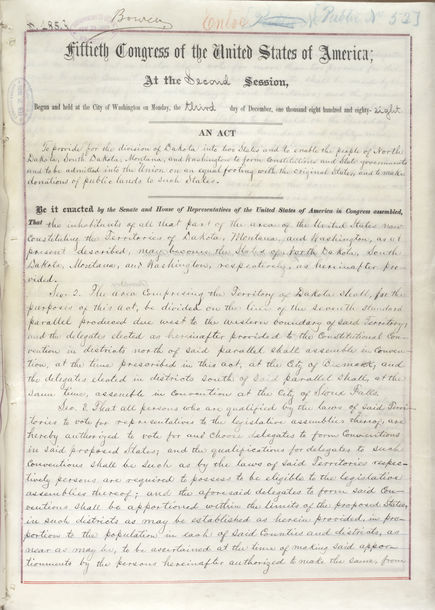
Wyoming's admission in 1890 was part of a larger wave of western state additions. In February of 1889, a single bill admitted North Dakota, South Dakota, Montana, and Washington as states in the Union. Although this was technically done without a Republican Trifecta - both the House and the President were Democratic Party controlled - it was signed during a lame duck period right before the inauguration of the 1888 election Republican tri-fecta government. Wyoming was then admitted in 1890 with an active tri-fecta government, and was intentionally admitted prior to the 1890 midterm elections. This move ended up being futile in preserving a Republican stronghold, but does lay some precedent for small states being admitted to try to preserve a party's strength.
That's the real-world precedent for the trifecta argument the rest of this piece makes - not hypothetical, just modest in scale. The only thing that's changed since 1890 is how far the same play could be pushed.
How a Same-Party Trifecta Could Abuse This
This is where the historical curiosity turns into a real, if extreme, strategic tool. Suppose one party controls the House, the Senate, and the Presidency - a trifecta - and also controls the legislature of one large state. Article IV, Section 3 gives that combination a path that a federal trifecta alone does not have:
- The state legislature votes to divide itself into many new states, drawing the new boundaries to concentrate its own party's voters into as many small states as possible.
- One leftover state absorbs everyone else - including the bulk of the opposition party's voters - no matter how large that remainder state ends up being.
- Congress admits all the new states in one or more ordinary statutes, signed by the President.
The primary payoff is Senate seats and Electoral College votes, not House seats. Because every state gets exactly two Senators regardless of population, splitting one large state into, say, ten friendly small states turns 2 Senate seats into 20, while the opposition-heavy remainder state - even if it holds most of the original population - is still capped at 2.
This is not a purely theoretical thought experiment; versions of it have been floated seriously:
- "Six Californias" and the later "Cal 3" ballot measure proposed splitting California into multiple states, explicitly discussed in terms of the Senate seats it would create.
- "Pack the Union", a Harvard Law Review piece, proposed carving many small new states out of federal territory for the explicit purpose of amending the Constitution. Note that new states supply both halves of Article V: Congress proposes an amendment by two-thirds of each chamber, and the states ratify it by three-fourths.
- Analysts have periodically noted that splitting a large state - New York has come up as often as California - would shift the Senate by exactly the number of new states created, in either party's favor depending on who controls the legislature doing the splitting.
Many 75,000-Person States
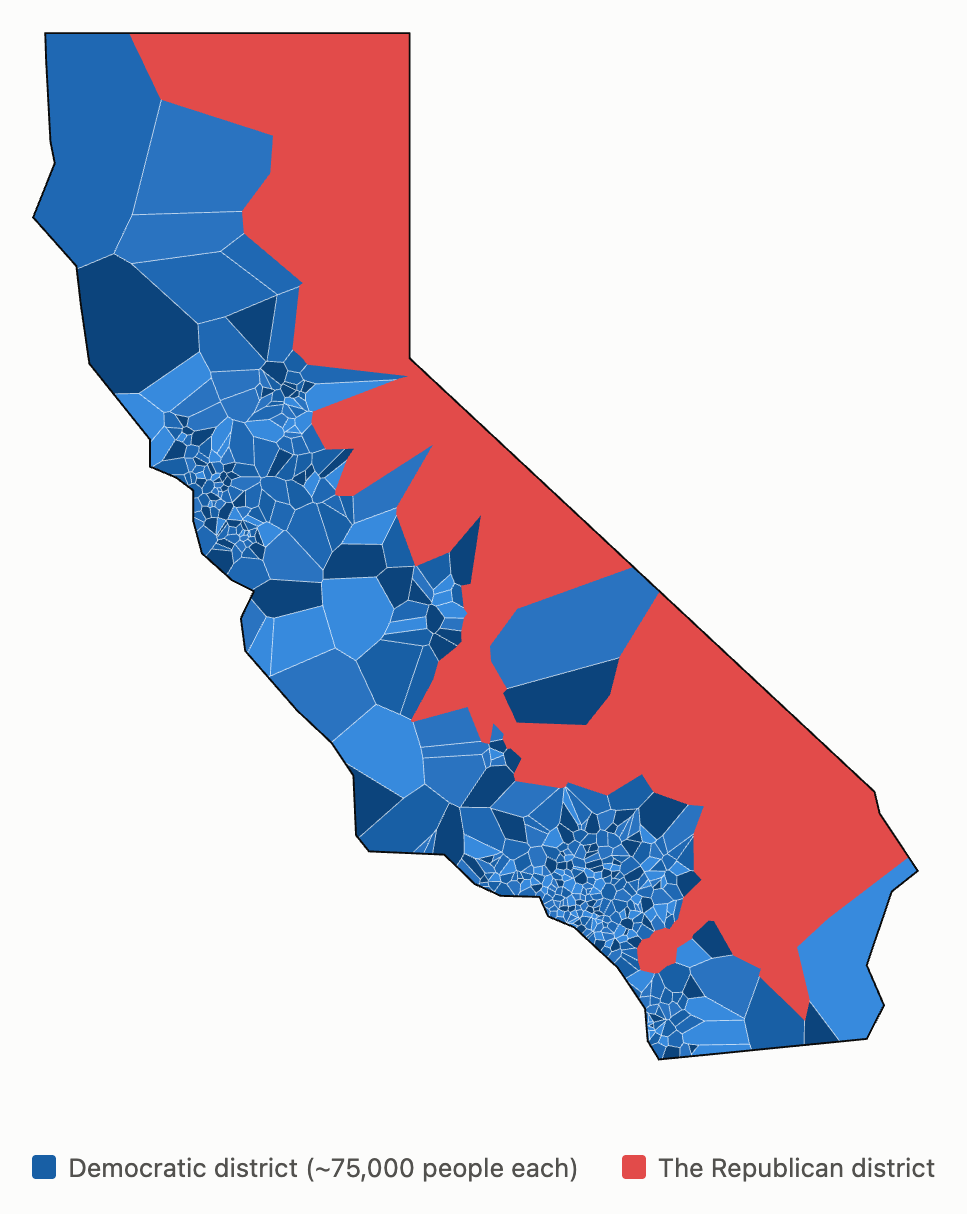
Nothing in the math above caps the number of new states at ten. Push the same mechanism further, while staying well inside a size Congress has already treated as an ordinary state. Use 75,000 as a basis, which is above Wyoming's size at admission and comfortably above the 30,000-person ratio in Article I, Section 2, so none of the apportionment math below runs into a wall.
Suppose a Democratic-controlled trifecta, with a Democratic-controlled California legislature, identifies roughly half of California's population - about 19.5 million people, spread across whichever counties and precincts vote most reliably Democratic - and draws that territory into states of 75,000 people each:
19,500,000 ÷ 75,000 ≈ 260 new states.
The other half of California - every Republican, plus anyone not sorted into a friendly district - becomes the one remainder state, same as in the general mechanism above. (The party labels are interchangeable; a Republican trifecta holding the Texas or Florida legislature runs the identical play with the names swapped.)
Drawing 260 separate districts that are simultaneously population-exact, politically homogeneous, and geographically contiguous is a nontrivial map-making problem in its own right - closer to running 260 rounds of redistricting than doing one division problem. Nothing about that requires any new legal authority beyond what ordinary redistricting already uses, but it's a real engineering constraint on the scheme, not just arithmetic.
Run the same three numbers:
- Senate: 260 new states × 2 Senators = 520 new Senate seats, replacing the 2 the whole state used to have. The remainder state, no matter how many people end up living there, still gets 2.
- House: 260 new states each need a minimum of one Representative - 260 new seats. That's real, but nowhere near a constitutional problem: the country's total population (roughly 349 million) caps the entire House, nationally, at about 11,600 seats under the 30,000-person ratio, and today's House uses only 435 of that room. Adding 260 more spends a sliver of headroom that's already there.
- Electoral College: 260 × 3 = 780 new electoral votes, against roughly 54 for the whole of California today (52 House seats plus 2 Senate seats).
That's already a bigger distortion of the Senate than anything in American history, and unlike a scheme built around literal one-person states (if you want to see how far that idea goes, it's in the appendix), it doesn't need any exotic legal theory to survive. It doesn't need a property trick to survive migration, because 75,000 people spread across real neighborhoods isn't a fragile one-vote monopoly that a single new resident can flip - it's an ordinary political majority, the kind that already exists inside plenty of state legislative districts today. It doesn't strain the Guarantee Clause the way a fief built around one landowner's front door does - a state of 75,000 people with its own government looks, on paper, exactly like the states already in the Union. And it doesn't touch the apportionment ceiling at all.
There's a further wrinkle worth noticing. Replacing 1 state with 261 (260 friendly states plus the remainder) brings the total number of states in the Union to 310. Holding 260 of those 310 state legislatures is about 84% - past the three-fourths of all states that Article V requires to ratify a constitutional amendment, using nothing but the split of this one state. That's a snapshot of control at the moment of creation, not a permanent lock - 260 separate legislatures will hold their own elections and can drift apart or realign over time like any other states. But whatever else this maneuver is, it isn't only a Senate or Electoral College play.
What Actually Blocks This From Happening Overnight
-
The real blocker is the reaction, not the procedure. Take the 75,000-person version seriously for a moment: roughly 19.5 million people - the entire other half of California - would be told, permanently and by arithmetic that they have no path to influence the Senate or the Presidency again. Nearly all other 49 states would find themselves in the same situation, with their existing 2% influence in the Senate getting diluted to 0.3% overnight. If the House of Representative seats are expanded, the other states get a 1.6x dilution in the House and a 2.6x dilution in the Electoral College. If the House stays the same size of 435 members and seats are reapportioned, there is even further dilution.
That isn't a policy defeat to absorb gracefully; it's the textbook precondition for a secession movement. A backlash from 49 states whose residents are dramatically disenfranchised is the more realistic version of "the reaction." The deterrent isn't that civil conflict would somehow prevent the bill from passing - a consequence is not a procedural obstacle. It's that the legislators who would have to vote for it can see the consequence coming in advance, and a Senate majority bought at the price of a secession crisis and a fifty-state backlash is not obviously a majority worth having.
-
You need the same party controlling the House, Senate, and Presidency, plus that state's own legislature, at the same time. That's a real requirement, but not a rare one - a party's biggest, safest states tend to already be under its unified control whenever it also holds the federal trifecta. Texas and Florida for Republicans, California and New York for Democrats, have been reliably one-party states for decades.
-
Whether the state's own legislators are voting against their own interest is less clear than it looks. Splitting one state into ten doesn't just eliminate 2 Senate seats and 1 governorship - it creates 20 Senate seats, 10 governorships, and 10 full sets of legislative leadership where there used to be one. For an ambitious state legislator, that's a bigger lottery of offices, not a smaller one. The real friction isn't self-sacrifice; it's that only a fraction of the people voting for the split can actually win one of the new seats, so the plan only holds together if party leadership can make credible promises about who gets what before the votes are cast.
-
The Senate filibuster, but barely. Admission acts are ordinary legislation, so absent a rules change they need 60 votes. This is the weakest item on the list: the filibuster is a Senate rule abolishable by simple majority, as the chamber demonstrated in 2013 and in 2017, and a party willing to carve a state into 260 pieces will not be deterred by a procedural norm it can repeal in an afternoon. After the first round of admissions it is irrelevant permanently.
-
Equal Protection offers the closest judicial analogy, and it's a weak one. Reynolds v. Sims (1964) requires rough population equality across state legislative districts under the Fourteenth Amendment - "one person, one vote." But the Court in that same case explicitly refused to extend the principle to the U.S. Senate, because the Senate's two-per-state structure isn't a state's own malapportionment choice; it's what the Constitution itself commands, and the Fourteenth Amendment doesn't override Article I. And if the real objection is to the partisan motive behind drawing 260 states instead of ten, Rucho v. Common Cause (2019) held that partisan-gerrymandering claims are nonjusticiable political questions under the federal Constitution - there's no judicially manageable standard for how much partisan advantage is too much. Rucho left room for state courts to police gerrymanders under state constitutions, but that doctrine targets ordinary legislative districts, not the admission of whole new states under Article IV, so it's unclear it would even reach this maneuver.
-
Equal footing cuts both ways. Coyle v. Smith stops Congress from admitting a state with lesser status, but it doesn't stop Congress from admitting many small, equal-status states - so it's not a defense against this strategy, just a reason the new states would be "real" states with full rights once created.
-
Precedent risk is mutual. Whichever party does this first hands the other party the same playbook the next time the alignment favors them, which has historically made both sides wary of being the one to break the norm - the same argument that comes up in modern D.C. and Puerto Rico statehood debates.
-
The paperwork is its own mountain. Even with the votes in hand, 260 new states means 260 new federal court districts to define, 260 new election-administration regimes to certify, a Census Bureau process built around 50 units now running for 310, and Postal Service and federal-benefits systems keyed to state boundaries that no longer resemble anything they were built for. None of this stops a Congress that has already decided to do it, but it's real friction that would stretch the timeline well past a single legislative session - and it would scale up sharply if other large states' legislatures tried the same maneuver, not just California's.
The conclusion I have is that if the political prerequisites are in place (a tri-fecta federal government including a super-majority in the Senate) then political will, not any obvious bright-line rule in existing constitutional doctrine, is the main thing standing in the way. That's not quite the same as saying constitutional law is irrelevant: whether the equal-Senate-suffrage clause in Article V can itself be amended away using the very procedure it constrains is a genuinely unresolved question, and nobody has ever tried it. The risk of secession and serious political backlash would be substantial, and house and senate members would need to vote more for party than for their own state's constituents or even their own self-interest since their influence will be diluted. These are all very real barriers which makes the proposal more of an intellectual exercise than a pragmatic reality.
Appendix: Could a One-Person State Exist?

Everything above works with ordinary-sized small states - real places with real neighborhoods, the kind Congress has actually admitted before. It's worth pushing the idea past that, if only because the Constitution's text doesn't visibly stop you, and the exercise exposes some genuinely strange corners of constitutional law along the way. Consider this the fun, consciously absurd version: how far could "small" go if nothing but the bare text constrained it?
Nothing in the text stops it. There is no enumerated population minimum anywhere in Article IV. The only two checks are:
- The Guarantee Clause, which Luther v. Borden treats as non-justiciable - so it's mainly a political argument Congress could raise against admission, not a bar courts have historically been willing to enforce.
- The ordinary legislative process - a House majority, the Senate's de facto 60-vote cloture threshold described earlier, and a presidential signature or veto override.
So the honest answer is: there's no textual bar, and no court has ever been willing to enforce one - which is not quite the same claim as "a one-person state is settled, affirmative law." Nobody has tried it, so nobody actually knows. What's clear is that it would take Congress wanting to do something transparently disproportionate - a one-person state would still receive two Senators and a House seat, the same baseline representation as California's 39 million residents. That's not a loophole anyone stumbles into; it's a decision Congress would have to make on purpose, with the political fallout in full view.
Could it stay a one-person state? Not by any governmental mechanism. Admission doesn't freeze a state's population, and nothing lets a state wall off its own citizenship: the Privileges and Immunities Clause and the Fourteenth Amendment's right to travel guarantee that any U.S. citizen can move to any state and immediately become one of its citizens, entitled to the same treatment as everyone already there. In Saenz v. Roe (1999) the Supreme Court struck down even a one-year waiting period before new California residents got equal welfare benefits, holding that a new arrival's citizenship in their new state is instant rather than earned over time. Voting specifically runs on its own, separate timeline - more on that below.
But that binds the state, not a private landowner, and the difference turns out to be the whole ballgame. Draw the state's boundary as exactly one person's house and lot and there is no public land to arrive on. Saenz guarantees equal treatment once you are a resident; it does not create a right to be physically present somewhere you have no lawful right to be, and domicile - presence plus intent to remain - is not something a court will credit when the presence is ongoing trespass. Nor is the usual squatter's escape hatch available, because the microstate writes its own property and trespass law and its own courts decide residency disputes: the adverse possession period is however many centuries the sole legislator says it is. Exclusion by deed is far more durable than exclusion by statute, precisely because the Constitution polices the latter and ignores the former.
The leaks that remain are about ownership changing hands, not about anyone moving in:
- The parcel is alienable. It can be sold, inherited, or split in a divorce, and two Senate seats are worth immeasurably more than a house - so each microstate is a purchasable asset with a discoverable price, and devices meant to lock ownership down in perpetuity (trusts, entails) erode against the rule against perpetuities. One owner might hold the line. Across a million of them, over decades, the defection rate is not zero.
- The household votes, eventually. A spouse, an adult child, a live-in caretaker, a houseguest who stays - anyone the owner admits and who intends to remain becomes a resident, though not instantly: Dunn v. Blumstein (1972) struck down long durational residency requirements for voting but blessed roughly 30 days as the outer edge of what a state may require to administer an election. So the electorate is "whoever the owner admits, after about a month," which is still not the same thing as one person, and a bad divorce could flip a Senate seat within a single election cycle.
- Federal eminent domain, conditionally. Washington can condemn land inside any state, and Evans v. Cornman (1970) held that residents of a federal enclave must be allowed to vote in the surrounding state. But that holding turned on Maryland exercising general criminal and taxing jurisdiction over the enclave's residents, so the lever works only if the microstate retains that jurisdiction - a cession of exclusive federal jurisdiction would likely cut the other way.
- Nobody can enforce any of it. A state whose entire police force is one person has trespass law in the sense that a sign on a fence is law. Enforcement means borrowing federal marshals or the neighboring state's deputies, and the microstate controls neither.
The property trick also creates a constitutional problem of its own, and it is a much better version of the Guarantee Clause objection than "one person cannot be a republic." If the boundary is drawn so that the state's electorate is determined by a single landowner's right to exclude, then the franchise has become an incident of private property. That isn't a republican form of government; it's a proprietary fief. And unlike a vague complaint that a tiny state feels unrepublican, it states a standard a court could actually apply - which matters, because everything that follows depends on the assumption that no court will intervene.
That assumption is shakier than it looks. Luther v. Borden treats Guarantee Clause questions as a political question beyond judicial reach, but courts have a track record of reaching the same kind of claim by a side door instead of the front one. Baker v. Carr (1962) made legislative districting justiciable by recasting what could have been a Guarantee Clause complaint as an Equal Protection claim instead, and in New York v. United States (1992) the Court expressly reserved the possibility that "perhaps not all claims under the Guarantee Clause present nonjusticiable political questions." Recasting the claim under a different doctrine is exactly the move available here too - which is what the next argument does.
There's a second, more specific doctrine pointing the same direction: Shelley v. Kraemer (1948) held that a court enforcing a private exclusionary arrangement - there, a racially restrictive covenant - is itself state action reachable under the Fourteenth Amendment, even though the private agreement alone would have been beyond the Constitution's reach. A microstate's own courts enforcing trespass to keep a would-be voter out is the same structure: private exclusion, backed by judicial enforcement, which is exactly the seam Shelley found. The caveat is that Shelley has been kept almost pointedly narrow in the decades since - taken literally, it would turn ordinary enforcement of any private exclusion into a constitutional question, so courts have confined it close to its facts. It's a second plausible line of attack, not a settled one.
Which leaves whoever is designing this scheme with a choice, and no good version of it. Draw the microstates as private parcels and they are migration-proof, but you have handed a court the cleanest Guarantee Clause hook anyone has articulated. Draw them as ordinary territory with public roads and public land and the fief problem evaporates - but so does the power to exclude, and a state with one voter and a public road is the easiest jurisdiction in the country to flip. The two vulnerabilities are the same design decision seen from opposite ends.
What happens if the sole resident dies? Usually the same thing that happens to any house: it passes to an heir. The heir doesn't inherit the governorship or a Senate seat directly - a deed transfers property, not public office - but they do inherit the only lawful right of occupancy in the state, and the state's own election laws, written by its sole resident, turn that into the offices soon enough: the heir moves in, establishes residency, and wins every election unopposed because there's nobody else there to run against them. That's the mundane answer, and it follows from the design - a state built on a parcel has politics that are only ever as stable as its estate planning. Two Senate seats would make for remarkable will contests.
The genuinely unresolved case is when nobody inherits. No U.S. state has ever had its population reach zero, and the Constitution has no mechanism for "un-admitting" one: Texas v. White (1869) held the Union to be a compact of "indestructible States," so a state cannot be dissolved unilaterally by anyone, Congress included. The state would simply continue to exist with nobody in it - no governor to appoint a replacement Senator, no legislature, nobody to hold an election. There's even a small knot in the escheat rules, under which property left with no heirs passes to the state: here, the state is the decedent. A careful admission act would head all of this off by providing that the state's offices need not be held by its sole resident - a governor, legislature, and judiciary existing on paper, staffed by people who live elsewhere, the way a shell company has officers. That such a clause would be necessary is the tell. The closest real-world analogue, uninhabited U.S. possessions like Palmyra Atoll, are deliberately kept as federally administered territories rather than states, precisely to avoid handing self-government and two Senate seats to a place with nobody to self-govern.
References
- U.S. Constitution, Article IV, Section 3 - the admission clause
- U.S. Constitution, Article IV, Section 4 - the Guarantee Clause
- U.S. Constitution, Article V - the equal Senate suffrage entrenchment clause
- Luther v. Borden, 48 U.S. 1 (1849) - Guarantee Clause claims as a political question
- Coyle v. Smith, 221 U.S. 559 (1911) - the equal footing doctrine
- Baker v. Carr, 369 U.S. 186 (1962) - apportionment made justiciable via Equal Protection, routing around Luther
- Reynolds v. Sims, 377 U.S. 533 (1964) - one person, one vote for state legislative districts, with an express carve-out for the U.S. Senate
- Rucho v. Common Cause, 588 U.S. 684 (2019) - partisan-gerrymandering claims are nonjusticiable under the federal Constitution
- Saenz v. Roe, 526 U.S. 489 (1999) - new residents become full citizens of a state instantly
- Evans v. Cornman, 398 U.S. 419 (1970) - federal enclave residents vote in the surrounding state
- Dunn v. Blumstein, 405 U.S. 330 (1972) - durational residency requirements for voting, and why ~30 days is the accepted outer limit
- Shelley v. Kraemer, 334 U.S. 1 (1948) - judicial enforcement of private exclusion as state action
- Texas v. White, 74 U.S. 700 (1869) - states can't be unilaterally dissolved from the Union
- Virginia v. West Virginia, 78 U.S. 39 (1871) - resolved only the Berkeley/Jefferson county question, not the constitutionality of the original 1863 separation
- United States Dep't of Commerce v. Montana, 503 U.S. 442 (1992) - the constitutional apportionment ratio in Article I, Section 2
- National Archives: West Virginia Statehood
- Wikipedia: 1888-89 United States Senate elections - the Senate seat gains from the 1889-90 Omnibus admissions
- History.com: Nevada Admitted as the 36th State
- Harvard Law Review: "Pack the Union"